An ocelot, photographed by Fortunato Rayan, using a camera trap.
It is a cool night at the Cocha Cashu Biological Station wildlife reserve in Manu. After a long day of rain, the clouds have subsided and after giving us a colorful sunset, they allow the moon to show itself in all its splendor. The now still waters of the lagoon reflect the night light, outlining the tall forests with a mysterious clarity. It is my third day at the station, and Fortunato Rayan Perez, my good friend and guide on this visit, invites me on a night walk along the trails on the opposite shore.
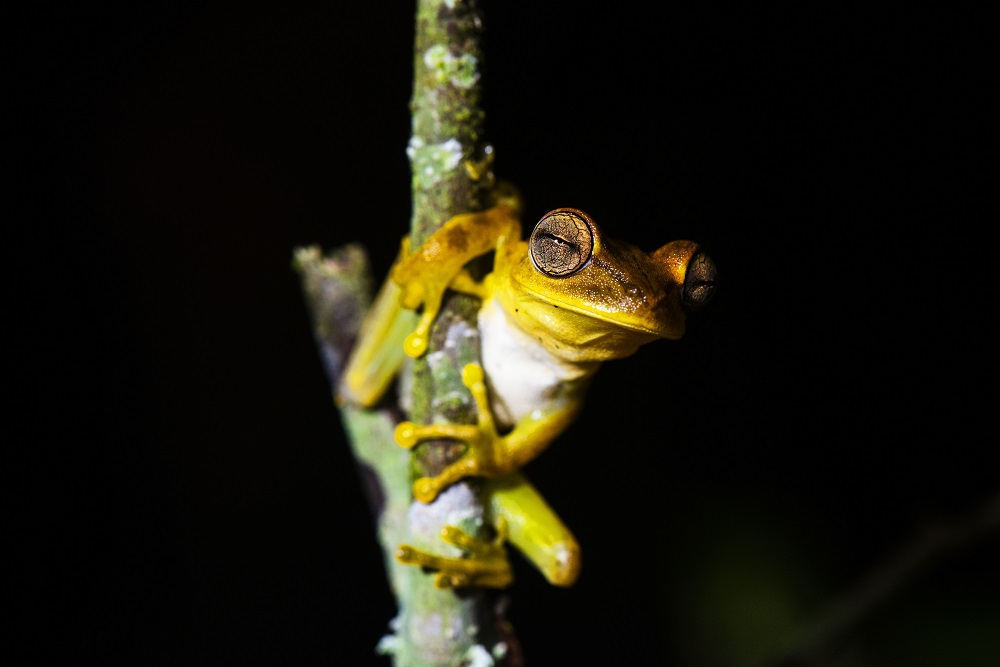
A Night Walk at Cocha Cashu Biological Station
Walking at night in the jungle is an unsettling adventure that always brings us wonderful encounters. As we cross the oxbow lake, almost without making a sound, we hear the choral songs of frogs, the plaintive hooting of a potoo, and over them all, the hoarse and powerful call of a howler monkey, perhaps the most representative sound of these pristine places.
Camera Traps and Wildlife Documentation in Manu
Well equipped with flashlights and our photographic equipment, this hike has two purposes: to discover life that is not possible to observe in daylight, and to check the camera traps that Fortunato must diligently monitor on a permanent basis. Thanks to the help of photographers who have visited the station in recent times, Fortunato has managed to develop a new way of capturing wildlife using professional cameras, with the help of a complex detection and lighting system. In this way, he has photographed peccaries, margays, pumas, tapirs and other large mammals that would otherwise be impossible to document. And in full color.
Cameras in hand, we set off on the hike through muddy trails. Only a trained eye like Fortunato’s can spot even the tiniest inhabitants of this night, barely illuminated by pale moonbeams filtering through the treetops.
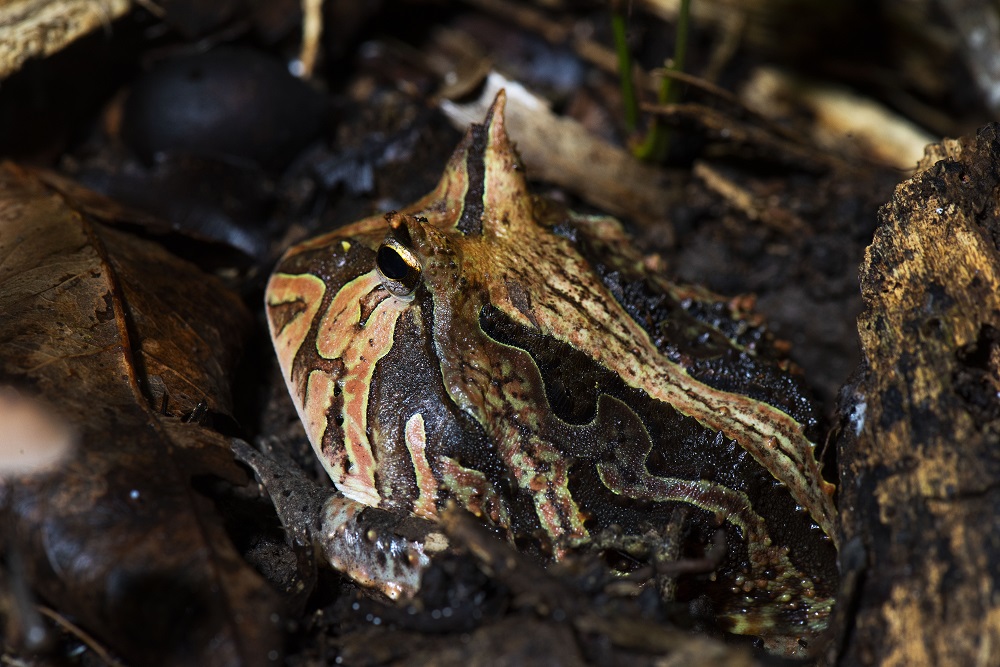
Cornudito
“There!” he suddenly says to me, pointing his flashlight at the ground. A horned frog, camouflaged in the leaf litter, lies still, waiting for prey. A few steps further on, a pair of crickets is trying to mate when they are interrupted by our flashlights. We leave them alone and move on.
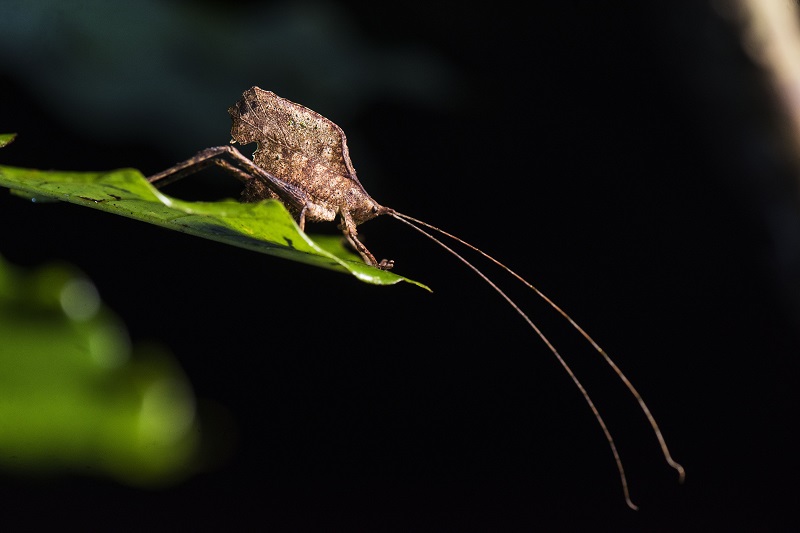
Suddenly, there is a commotion among the nearby vegetation. Startled by our footsteps and our voices, a peccary retreats without giving us time to activate our cameras. All that remains is its deep pungent smell and our amazement at such a close encounter.
The Forest Never Rests: Cocha Cashu Wildlife at Night
Spiders at work weaving, small frogs camouflaged on the ground and in the low leaves near pools, insects of all shapes and colors are part of this landscape that never rests. There is always someone eating someone else, some making their traps, others stalking their prey, tiny organisms breaking down the organic matter on the forest floor, endless symphonies on every branch, on every leaf, on every trunk. Multiplied life pulsing every second in the most diverse home on Earth.
After an hour’s walk, and with our eyes -and cameras- full of wonderful images, we arrive at the place where Fortunato has his “toys”. Methodically, he checks each of the five flashes, their trigger mechanisms, the shutter sensor and finally, the camera, leaving the best for last, to see if any unsuspecting animal has fallen into the photographic trap. Perhaps a puma or a jaguar, a peccary or a large tapir decided to walk the trail and was immortalized in its nocturnal wanderings.
An Unexpected Encounter: The Ocelot of Cocha Cashu
Immersed in our work we barely notice that two of the flashes have been activated in front of us. When we raise our heads in unison and point our flashlights, we see a young ocelot peeking over the huge fin of a ficus. It is he who has activated the sensor, and has approached us, overcome by curiosity. Frozen by the chance encounter, he gives us a curious look, perhaps gauging the danger and considering his chances of getting rid of these two mammals hitherto unknown to him. Most photographers would have raised their cameras to take a valley of photos of the animal – one of the most elusive and difficult to see in the vast Amazon – but something in us stops us. As if it were part of a plan, Fortunato and I become absorbed. Somehow, our gazes and the animal’s meet, and for an instant that seems like centuries we feel a strange, sisterly connection. For a short time, we understand each other and make each other feel that we will not hurt each other, that this encounter is as casual as the one we have daily with friends in the streets of our homes.
The ocelot hesitates for a moment, considering whether to continue along the trail or go back the way it came. As if it were a big house cat, it wiggles its ears, lifts one of its paws and says goodbye to us, disappearing into the darkness almost without making a sound. Fortunato and I breathe, incredulous, recording our encounter in the depths of our minds. We make our way back in silence, filled with that magic that only an experience like this can transmit. On our return, our colleagues reproach us for the lack of photos of the meeting. But, though it cannot be shown, that image will exist forever engraved in our hearts.

